Having read one of Tasmin's posts over on her Wargaming Girl blog where she set out her achievements in July and targets for August I decided to try setting some targets for myself for August, so here goes
Gaming
6 games. I have a Warmachine game set up for Monday and an Ancients game organised at a friends house on the 10th so that is another 4 to get sorted
Blogging
Blog each game played plus another 4 posts (this counts as 1 of the 4!)
Painting
My Achilles heel. I have 2 small 28mm squads that I really want to get done - 1960's British Infantry and Pig Iron SF troopers. If I succeed I will post pictures, although the paint jobs will be pretty basic
I will report back at the end of the month - lets see how well I got on and if putting a target like this on the blog really helps, particularly with the painting
Friday, 3 August 2012


Wednesday, 1 August 2012
Impetus 25mm or 15mm ?
I am a dyed in the wool 25mm wargamer for the period pre 1700, due in no small part to many years worth of investment in lead in this scale. Now that's not to say I won't give other scales a go when someone else is providing the toys. I was therefore able to play Impetus in two successive weeks, the first time in 15mm and the second in 25mm and I thought it would be interesting to compare and contrast the experiences.


Doug provided the figures for the first game, an Italian wars affair with me leading the French against the Imperialists. The scenario was that the French had completed a hasty deployment from camp with their foes attempting to take advantage of the fact. The main terrain feature was a river/stream which started about a third of the way in on my left, went straight across the battle field taking a sharp left fairly close to Doug's baseline as is hopefully visible in the attached photo.

I am on the left - Doug's army on the right
My cunning plan was to hold in the centre with my cavalry and missile troops (including some fairly good artillery) whilst my 2 pike blocks sped up the left flank firstly to deal with any opposing forces and then to cross the river into the flank of the opposition. This left my right flank a bit weak covered by a unit of skirmishing mounted harquesbusiers
Doug's deployment pretty much matched mine and his plan was simple - all out attack.
Both of us are much more familiar with 25mm Impetus wargaming and neither of us appreciated that fighting on a 6 x 4 board with a MU of 1 cm (as opposed to 2 cm for 25mm) it was going to take some time for contact to be established. When we worked out it would take 4 turns for a pike block to cross the river the penny started to drop.
The effect of the slow movement combined with the realisation that my advancing pike blocks could leave themselves open to some potentially devastating flank fire from across the river if they pressed forward too vigorously effectively took that flank out of the battle - the pike units did not get to contact.
In the centre I had the advantage of standing still whist my opponent tried to advance quickly whilst maintaining formation. This proved difficult as some units became disordered. My artillery inflicted minor damage again slowing up the advance somewhat.
First contact was between the lone unit of mounted harquebsusiers outnumbered 2 to 1 by stradiots and mounted crossbow. The stradiots were the lead unit and had the advantage in melee so Doug threw them in. This was the start of a series of melee dice rolls where mine were generally good and Doug's often woeful. Over the next couple of turns in the harquesbusiers took out first the stradiots and then the mounted crossbow to our mutual surprise.
In the centre I realised that I would have to loose my French knights whilst they still had their impetus and after a seesaw series of combats (and some more good dice rolls) they emerged victorious though bloodied and the facing command was broken.
At this stage we had to pull up stumps and although I had a bit of an advantage it was certainly not decisive.
The second game was against Kev's brand new 28mm Patrician Roman army. Almost exclusively made up of Musketeer Miniatures sculpts and beautifully painted they looked impressive. "Pretty boys but can they fight" was my tongue in cheek challenge. In contrast my boys are downright ugly. In an attempt to provide an historical opponent I combined Saxons and Huns and called them early Visigoths. The Huns are painted to wargames standard but the Saxons have been downgraded from poor to battered over the last 20 years. Perhaps a more charitable description would be grizzled veterans!
I drew up with 6 double units of foot in the centre screened by 3 units of skirmishing archers. The 2 units of heavy Visigoth cavalry were on my right (on Opportunity) and 2 units of Hun light cavalry on my left. Kev matched my 2 units of heavy cavalry with 3 of his own. Two large units of barbarian foot formed the centre of his line with 2 units of Roman foot on either side. Despite having some protection from a wood Kev's right flank did look a little exposed.
Both armies rolled forward with only my Heavy Cavalry staying back. In the next turn I to launched charges with both of them as they were within a double move. Kev's guys failed to counter charge so I crashed in with the advantage.
On the left flank I was able to squeeze the Huns onto that exposed flank and take out a unit of Roman foot. A series of bloody clashes followed between the two lines of foot with heavy casualties on both sides. The pretty boys showed that yes they could fight whist the ugly boys proved that a poor paint job and good dice rolls are not mutually exclusive.
The cavalry fight ground on. The third Roman unit, including the general, was rather trapped so the action took place in two one on one combats that I eventually won. Released, the general surged forward sweeping all before him but by this time the battle was just about all over.
Despite having been promoted by throwing a double 6 on initiative (Kev's was demoted on a double 1) my general fell leading his men from the front. Inspired by his sacrifice the Visigoths fought on and in the last turn both armies went over their break point so the result was mutual destruction!

The end of the battle from my side. On the far right my remaining unit of HC has burst through as has the Roman general. On the left I still have 2 units of Huns and in the centre things are even

Visigoth losses

Roman losses
So how did the two games compare? The 25mm game confirmed why I like playing Impetus on a Monday night at the club - lots of action and the game fought to a conclusion. It is not really fair to compare it to the 15mm game as in retrospect the set up and initial plans were based on 25mm experience - we should have either used a 2 cm mu or had a smaller board. Still an enjoyable game though.
No conclusive proof as to which scale is better then. I will keep playing with my 25mm armies but may dabble in 15mm when opportunities present themselves.
By the way thank goodness for the 'restore session' function. My laptop crashed just as I had completed the above but fortunately I did not lose any of it. Phew!
Saturday, 21 July 2012
Battle of The Nations Monument Leipzig
Leipzig, the "Battle of the Nations" was fought between 17th - 19th October in 1813. A memorial to this decisive victory against Napoleon was long planned and finally came to fruition for the 100th anniversary of the battle in 1913.
Prussians and Austrians fought the allies (along with Russians and Swedes) and Napoleon had a contingents from the Confederation of the Rhine and Saxony in his army(together with French and Polish). About 5000 Saxons changed side part way through the battle. Post German unification this was considered a particularly poignant battle as Germans fought and died in large numbers on both sides.
Hitler used the monument as a symbol of German pride and there was a move to pull it down during the communist era. It survived as it was felt to be a good example of Russians and Germans fighting as comrades in arms.
We only had a chance for a short visit and work is being done on it for the 200th anniversary of the battle in 2013 but hopefully the pictures will give an idea of the scale.


Prussians and Austrians fought the allies (along with Russians and Swedes) and Napoleon had a contingents from the Confederation of the Rhine and Saxony in his army(together with French and Polish). About 5000 Saxons changed side part way through the battle. Post German unification this was considered a particularly poignant battle as Germans fought and died in large numbers on both sides.
Hitler used the monument as a symbol of German pride and there was a move to pull it down during the communist era. It survived as it was felt to be a good example of Russians and Germans fighting as comrades in arms.
We only had a chance for a short visit and work is being done on it for the 200th anniversary of the battle in 2013 but hopefully the pictures will give an idea of the scale.

Long view with artificial lake to the front

Closer view

Close up of the statues near the top of the monument
Friday, 20 July 2012
The Soviet War Memorial in Berlin
I got the chance to visit this on a stop at the Brandenburg Gate. It was built in 1945 with rubble from the nearby Reichstag and commemorates 2000 Soviet dead in the Battle for Berlin
I found it quite impressive. The centrepiece is a large statue of a Soviet soldier set atop a semicircular set of arches The area in front has two 152mm gun-howitzer artillery pieces and two T34 tanks on plinths
I am glad that this has been well maintained by the unified city authorities as the temptation must have been to take it down or at least let it crumble away – West Berliners were not over fond of the monument I understand.
Piccies


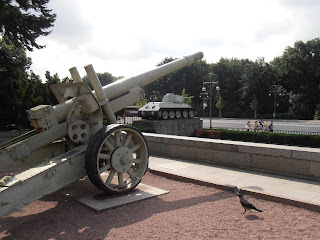

I found it quite impressive. The centrepiece is a large statue of a Soviet soldier set atop a semicircular set of arches The area in front has two 152mm gun-howitzer artillery pieces and two T34 tanks on plinths
I am glad that this has been well maintained by the unified city authorities as the temptation must have been to take it down or at least let it crumble away – West Berliners were not over fond of the monument I understand.
Piccies


The Berlin Wall
Following the end of the Second World War Berlin which was occupied under the four power agreement between The Soviet Union, USA , UK and France East Germany
Berlin


Prior to the construction of the wall in 1961 3.5m Germans had fled from East to West Germany Berlin West Berlin . However by 1961 the transport infrastructure had been put in place to allow West Berlin to be bypassed by road and rail and the decision was taken to close the border with a significant physical structure backed up with watch towers, bunkers and guards.
In terms of halting emigration the wall was a resounding success reducing it to a trickle. The damage to the international reputation of East Germany and the Soviet bloc has a whole however was substantial, particularly after the border guards were issued with shoot to kill orders which resulted in between 100 and 200 deaths
The eventual fall of the wall in 1989 is an iconic image of the collapse of Soviet communism Very little of it remains with most of it being physically destroyed in 1990. The line of the wall has been picked out in brick and snakes crazily across the city.

Surviving section - ironically now protected by a fence! It was generally about 12 feet high topped with a rubber cap to make it difficult to climb over

Myself and Angela in front of the wall
Wednesday, 18 July 2012
Germany Calling..........Germany Calling
Just back from a 12 day touring holiday of Germany. Lots of photos to download. I will do some short posts on the places of interest with piccies over the next few days.
Monday, 2 July 2012
Welcome to Allan and "biffing the enemy"
I’d just like to say thanks to fellow Falkirk club member Allan for becoming the latest Lead Warrior follower and take the opportunity to recommend his new blog
http://biffingtheenemy.blogspot.com/
http://biffingtheenemy.blogspot.com/
Subscribe to:
Posts (Atom)